A Multi-Agency Resource Center puts every agency a survivor needs in one building for one to three days. Survivors check in once, walk a short loop of tables, and leave with registrations started, claims opened and a recovery contact.
One lead agency owns the MARC. That is usually the county emergency manager or, for a federally declared event, the lead VOAD agency working with the state. The lead agency signs the facility agreement, names the Site Manager, sets the hours and approves every public message. Every other agency is a partner and brings its own people, paperwork and signage.
| MARC | Local. Run by the county or VOAD. Any disaster, declared or not. One to three days. Many agencies, broad help. |
| DRC | Federal. Run by FEMA after a federal declaration. Open for weeks. FEMA programs first, partners alongside. |
| Both at once | Fine, and common. Coordinate so neither one pulls survivors away from the other. A MARC often opens before the DRC does. |
Many disasters never reach a federal declaration. A MARC does not need one. FEMA and SBA will not be at the table, but your state's social services and labor agencies, legal aid, insurance carriers, Red Cross, Salvation Army, Catholic Charities, the county extension office and local churches all will. That is still most of the help a family needs.
The national planning resource describes five stages: steady state, planning, stand up, daily operations and stand down. Here is the same thing as a calendar for a county that decides on day 3 to open on day 10.
| When | What happens | Owner |
|---|---|---|
| Before any disaster | Keep a short list of three possible venues you have walked through. Keep the state agency contact list in this toolkit current. Know who at the Red Cross, Catholic Charities and Salvation Army offices that cover your county answers the phone. | County EM |
| Day 1 to 3 | Damage assessment. Rough count of affected households. Decide whether a MARC is the right tool: yes if more than roughly 25 households have real damage and need more than one agency. | County EM + EOC |
| Day 3: planning meeting | 60 minutes, in person or on a call. Agenda: needs by category (page 7), agencies to invite, lead agency, venue, dates and hours, who is PIO, who runs registration. Leave with assignments and the opening announcement drafted. | Lead agency |
| Day 3 to 5 | Send agency invitations (Forms Pack F6). Phone every one of them two days later. Sign the facility agreement. Order tables, chairs, pipe-and-drape. Book interpreters. Confirm childcare provider and background checks. | Lead agency, liaison |
| Day 7: announce | Public announcement at least 48 hours before opening (F7, F8). Radio, newspaper, county and city social media, school district robocall, church bulletins, flyers at shelters, pharmacies, grocery stores and the courthouse. Say what to bring. | PIO |
| Day 8 to 9 | Confirm every agency by phone. Print forms and passports. Make the damage verification map. Staff schedule finished. Signage printed in English and Spanish. | Liaison, Site Manager |
| Day 9, afternoon | Set up the hall per the floor plan. Walk it as a survivor would. Partner preparation meeting at the venue: code of conduct signed, table assignments, hours, how referrals between tables work, media rules. | Site Manager |
| Day 10 to 12: open | Daily 15-minute huddle before doors open. Collect counts hourly. Fix problems the same day. Daily press note on what was provided. | Site Manager, all |
| Close + 48 hours | Compile numbers. Debrief partners (F10). Thank everyone publicly. Hand the registration list and unmet-needs list to case management or the long-term recovery group. | Lead agency |
| Close + 2 to 3 weeks | Decide on a second MARC. Survivors get FEMA and insurance letters in this window and come back with new questions. | Lead agency |
End it with one sheet: venue, dates, hours, lead agency, Site Manager, PIO, and the list of invited agencies with a name beside each. If a line is blank, someone owns filling it by tomorrow noon.
Close to the damage, but not in it. Short drive for survivors, on a road people already know, with utilities that the disaster did not knock out. Walk it with the building owner before you sign anything.
| Venue type | Why it works | Watch for |
|---|---|---|
| School gym | Size, parking, accessible, known to everyone, often free after a disaster | Classes resume. Ask for a weekend plus one weekday evening. |
| County expo or fairground building | Huge, loading doors, parking, paved pads for trailers | Heat and cooling, internet, long walk from the parking lot |
| Church fellowship hall | Kitchen, classrooms for private rooms, volunteers come with it | Some survivors will not enter a church. Keep signage neutral. |
| Community college or civic center | Internet, accessibility, rooms | Cost and scheduling |
| National Guard armory | Secure, large, generator | Military setting can feel unwelcoming to some families |
If damaged households are spread over 40 miles, run a half-day MARC in each affected town rather than one big one at the county seat. Three agencies in a community center beat ten agencies nobody can drive to. The same forms and passport work at any size.
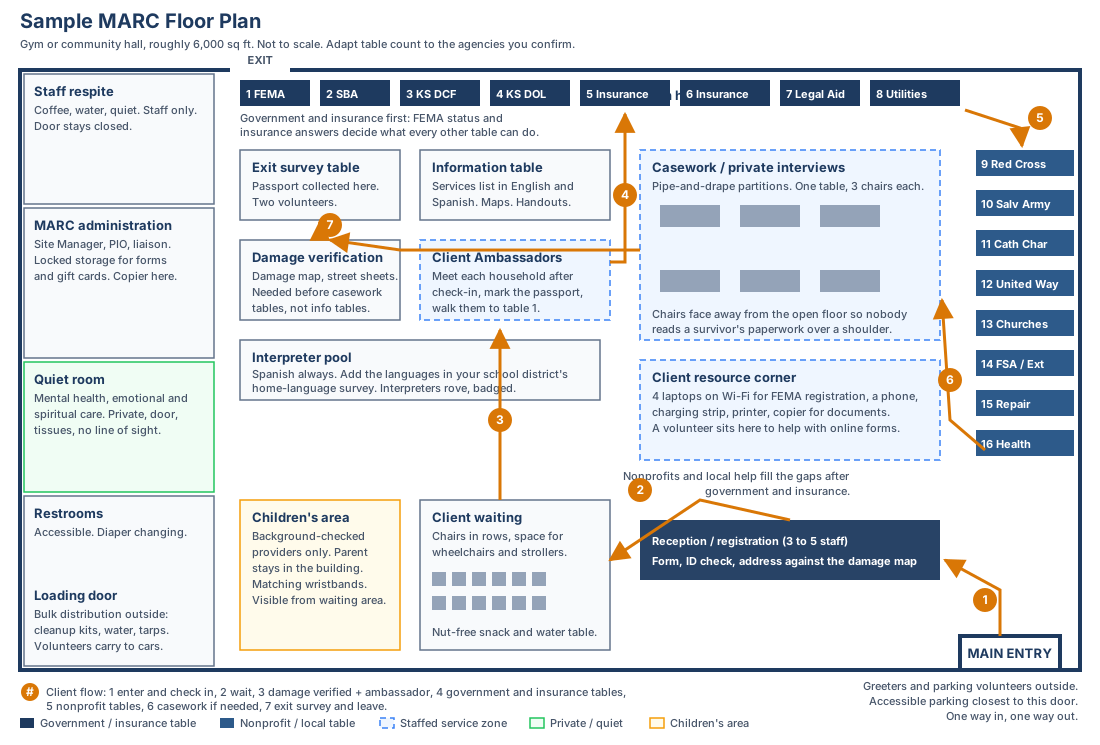
Adapted from Appendix M of the national MARC Planning Resource. Tables 1 to 8 are government and insurance; tables 9 to 16 are nonprofit and local. Swap names for the agencies you actually confirm, keep the order.
Household name, phone, damaged address, current address, household size, needs checked, which tables were visited, and whether follow-up is wanted. That is the whole list. Keep forms in a locked box; only the lead agency and case management see them. Ask consent on the form before any agency gets a copy.
If an address is not on the map, the Ambassador handles it: a photo on a phone, a neighbor, a utility bill. Information tables never require verification. Being strict here costs you trust with the exact people the MARC exists for.
For a MARC expecting 100 to 150 households a day. Scale down for a small town, but never drop the Site Manager, reception or ambassadors.
| Role | What they do | How many | Who usually fills it |
|---|---|---|---|
| Site Manager | Runs the building. Approves spending and press. Chairs the morning huddle. Mediates between agencies. | 1 | County EM or deputy, or Red Cross / Catholic Charities lead |
| Assistant Site Manager | Covers the Site Manager. Often also the partner liaison. | 1 | EM staff, VOAD member |
| Partner Agency Liaison | Keeps the agency roster, collects partner forms and code of conduct, assigns tables, tracks who is present. | 1 | VOAD or United Way |
| Public Information Officer | All public messaging, media at the door, daily summary. | 1 | County PIO, city communications |
| Safety and Security | Parking, crowd, exits, evacuation plan, incident log. | 1 + 2 parking | Sheriff's office, CERT |
| Reception | Registration, sign-in, verification, forms filed. | 3 to 5 | EM staff, library staff, CERT, trained volunteers |
| Client Ambassadors | Navigate families, mark passports, catch anyone stuck or upset. | 4 to 6 | Red Cross casework volunteers, church volunteers, extension staff |
| Greeters | Door, clipboards, first read on needs. | 2 to 3 | Any trained volunteer |
| Interpreters | Roving, badged. Spanish always. | 2 to 4 | School district, hospital, churches, Catholic Charities |
| Childcare | Supervised play area. Parent stays in the building. | 2 to 4 | Licensed provider, Child Care Aware, Southern Baptist DR |
| Emotional and spiritual care | Quiet room. Not interchangeable with mental health, but both present. | 2 | Community mental health center, chaplains, Salvation Army, Red Cross DMH |
| Runners | Supplies, copies, water, fix problems. | 2 to 3 | CERT, youth groups with an adult |
| Partner representatives | At least one per agency for every open hour, with a backup. | 1 per agency | The agency |
Spontaneous volunteers will show up. Have a sign and a phone number sending them to the volunteer reception center or the lead cleanup organization. Untrained walk-ins can set up chairs and hand out water. They do not sit at casework, childcare or health tables.
Match the invitation list to the needs you found in damage assessment. The full contact list with phone numbers is a separate sheet in this toolkit. Agencies in bold are typically members of your state VOAD.
| Need | Invite | Notes |
|---|---|---|
| Registration and federal aid | FEMA Individual Assistance, SBA Disaster Loans | Only after a federal declaration. Otherwise laptops for DisasterAssistance.gov in case it comes later. |
| Food, cash, Medicaid | Your state's social services agency, Medicaid, WIC | Usually the state's ESF-6 lead. Ask about replacement SNAP for food lost to power outage. |
| Lost wages | Your state labor department, Disaster Unemployment Assistance | DUA only with a federal declaration. Regular UI otherwise. |
| Insurance | Every carrier with policies in the county; your state insurance department's consumer line | Farm Bureau, State Farm, American Family, Shelter are usually willing. Ask the local agents. |
| Legal | Legal aid, the state bar's disaster legal hotline | Insurance disputes, contractor fraud, lost documents, landlord issues, FEMA appeals. |
| Emergency relief | American Red Cross, The Salvation Army, Convoy of Hope | Comfort kits, cleanup kits, financial assistance, feeding at the MARC. |
| Casework and recovery | Catholic Charities, United Way, community action agencies | Catholic Charities often carries long-term disaster case management. |
| Cleanup and repair | Team Rubicon, Southern Baptist Disaster Relief, Samaritan's Purse, United Methodist ERTs, Habitat for Humanity, Mennonite Disaster Service | They sign up work orders at the table. This is where cleanup crews get their list. |
| Food supply | Your regional Feeding America food bank | Bulk distribution at the loading door. |
| Farm and ranch losses | USDA Farm Service Agency county office, the county extension office, your state department of agriculture | Livestock indemnity, fence, debris on cropland, stored grain. Essential in any agricultural county. |
| Health | County health department, Medical Reserve Corps, community mental health center, 988 | Tetanus after debris work, prescription replacement, crisis counseling. |
| Children | Child Care Aware, school district | Childcare at the MARC, school re-enrollment, counselors. |
| Documents and identity | State vital statistics office, driver's license office, Social Security, Veterans Affairs | Replacement birth certificates, licenses, benefit cards. |
| Utilities and housing | Electric co-op or utility, gas, water, telecom; USDA Rural Development; local housing authority | Billing holds, deposit waivers, reconnects, rental help. |
| Pets and livestock | County animal control, the regional humane society, local vets | Lost pets, feed, boarding. |
| Money and donations | Community foundation, local bank or credit union | Relief fund disbursement, payment deferrals, fee waivers. |
Spanish is the floor in most of the country, and many counties have more. Your school district's home-language survey is the best map of who lives in the damage area. Ask the district, the hospital and local faith communities for interpreters, and put a language card at reception so families can point.
Shift workers cannot come to a MARC that is open 9 to 4 on a Tuesday. Open at least one evening until 8 and a Saturday. Ask the largest employers in the county to post the flyer and to let people come during a shift.
Mixed-status households will not approach a table with a federal seal. Put nonprofit tables and the Ambassadors where they are seen first from the door. Say plainly on the flyer and at reception that nobody is asked about immigration status. Faith-based agencies are often the trusted door for these families.
In a rural county, damaged homes can be 30 miles apart. Plan satellite half-days in the smaller towns, or a mobile MARC with three agencies in a van, before you assume people will drive to the county seat.
Where there is agriculture, livestock loss, downed fence, debris on cropland and damaged grain storage are as urgent as a damaged roof. Invite the USDA Farm Service Agency county office and the county extension office to a table. Louisiana's agricultural MARC supplement (sources page) is a good model for rural service tables.
Build the invite list from the hazard. Tornado and wind MARCs lean on insurance, debris and housing. Flood MARCs lean on mold, well water testing and public health. Wildfire and ice storm MARCs lean on utilities, FSA and feeding. Hurricane MARCs lean on all of it, plus long shelter stays.
| Time | Action |
|---|---|
| 7:30 | Site Manager and Safety walk the building: exits, cords taped, signage up, restrooms stocked, first aid kit and AED located. |
| 8:00 | Partner agencies arrive and set tables. Liaison checks each one in on the Daily Agency Log (F4) and hands out the code of conduct if not yet signed. |
| 8:30 | Huddle, 15 minutes, everyone standing: who is here, who is missing, what changed since yesterday, where the lines were, one safety note. Ambassadors get the updated agency list. |
| 8:45 | Reception stocked: forms, passports, pens, clipboards, sign-in sheet, damage map, language card, locked box. Laptops online. Interpreters badged. Childcare open. |
| 9:00 | Doors open. Greeters and parking in place. |
| Every hour | Reception reads the sign-in count to the Site Manager. Runners refill water and forms. Ambassadors report any table with a line longer than six households. |
| Midday | Staff eat in shifts in the respite room, never at their tables. Snacks for clients restocked. |
| 30 min before close | Last entries logged. Anyone still in line is served. PIO drafts the daily summary from the counts. |
| Close | Forms and passports counted and locked. Agencies note follow-ups owed. Site Manager, Liaison and PIO do a 10-minute debrief. Building secured. |
| Problem | Do this |
|---|---|
| Line at FEMA or insurance | Pull a volunteer with a laptop to start registrations in the line. Move that table's second chair out so conversations are quicker. Offer a callback slot. |
| Agency no-show | Never leave the table empty. Put their handouts and phone number there with a volunteer. Collect names for a callback list and hand it to the agency the same day. |
| Survivor with no documents | Serve them anyway. Start the missing-documents list; legal aid and the state vital statistics office can replace most things. |
| Distressed survivor | Ambassador walks them to the quiet room. No audience. Mental health or chaplain takes it from there. |
| Media inside | PIO only. No photos of faces or paperwork without a signed release. Interviews outside the hall. |
| Donations dropped at the door | Thank them and send them to the donations site. The MARC does not sort goods. |
| Severe weather warning | Safety Manager calls it. Everyone to the designated shelter area you identified at the walk-through. |
| Metric | Why |
|---|---|
| Households served and people in them | The headline number for the county commission and funders |
| Share of affected households reached | Tells you whether to hold a second one |
| Needs by category | Sets the long-term recovery group's priorities |
| Visits per table | Shows which agencies to invite next time and where the lines were |
| Follow-ups requested and completed | The MARC is only as good as the calls made afterward |
| Exit survey scores and comments | What survivors felt. Quote them in the after-action report. |
This guide condenses and localizes public documents. Read the originals when you have time; they are the authority.
| Resource | What it is | Where |
|---|---|---|
| Multi-Agency Resource Center Planning Resource, v1.0 (June 2015) | The national 68-page planning document from American Red Cross, Catholic Charities USA and The Salvation Army, reviewed by FEMA. Stages, site selection, roles, sample layout, client process, 28 appendices with forms and checklists. This toolkit's forms are modeled on its appendices. | preparecenter.org (search "MARC Planning Resource") or nationalmasscarestrategy.org |
| Multi-Agency Resource Center Basics (MARCBAS) | Red Cross 45-minute online course built on the planning resource. Open to partners with a free EDGE account. | redcross.org, EDGE learning system |
| FEMA IS-288.A: The Role of Voluntary Organizations in Emergency Management | Free independent study course. | training.fema.gov |
| FEMA State and Local Referral Lists | FEMA's per-state list of agencies and hotlines by need category. The contact sheets in this toolkit start from it. | fema.gov/assistance/individual/disaster-survivors/state-local-referral-lists |
| Your state VOAD | The roster of voluntary agencies in your state, and where your after-action report should live. | nvoad.org (member directory) |
| Your state emergency management agency | State EM and its regional coordinators, plus the state response plan. | Search for your state emergency management agency |
| Missouri SEMA, "MARCs" (2024 conference deck) | Short state-level overview of principles, roles, client process and site selection. | sema.dps.mo.gov |
| Multi-Agency Resource Center Planning Resource for Agricultural Communities | Louisiana supplement for rural and farm MARCs. | ladrc.org |
| Response Team playbook: What Is a MARC? | The explainer that goes with this toolkit, plus guides on standing up an LTR, partner roles and case management. | responseteam.org/playbook/marc-explainer/ |
Prepared by Response Team (responseteam.org), a free resource hub for disaster recovery coordination built by the people behind Serve.Love. Free to copy, print and adapt. If you run a MARC with it, send us what you changed and we will fold it in for the next county. team@serve.love