The room, and what happens in it
A Multi-Agency Resource Center is a school gym or a fellowship hall, for two or three days, with every agency a disaster survivor needs sitting at tables around the walls. A family that lost its roof walks in once, tells its story once, and walks a short loop.
It is not a shelter, not a donations warehouse, and not a volunteer check-in. It is a coordination event, run by the local community, that compresses weeks of driving around into an afternoon.
Picture the gym. Along the far wall, the government tables: FEMA if the disaster was federally declared, the state's social services agency, the labor department, the insurance companies that write policies in the county. Along the side wall, the nonprofits. The people in orange vests are the ambassadors, who meet each family after registration, circle the tables worth visiting on a passport sheet, and walk them to the first one.
The one sentence
A MARC brings the agencies to the survivors, in one place, for a few days, so that recovery starts in one visit instead of a dozen.
Why one building beats twelve phone numbers
Recovery is a system of separate programs, each with its own eligibility rules, hours, forms and office, and the survivor is the coordinator by default. A MARC fixes four things about that.
It gets the order right. The government and insurance tables come first in the loop, so by the time a family reaches the nonprofits, those tables can act instead of saying "come back when you hear from your insurer."
It lets the agencies talk to each other. When the FEMA representative hears that a family was denied for a documentation reason, she can point across the room to the legal aid table.
It verifies once. The registration table checks the damaged address against the damage assessment map one time, and every table after that trusts the registration form.
It rebuilds trust. Seeing the sheriff's office, the Red Cross, the insurance company and the chainsaw crew in the same gym, pointing people to each other, changes how the community reads the response.
When a MARC is the right tool, and when it is not
A MARC is the right tool when enough households have real damage and need more than one program. There is no official threshold, but more than a couple dozen homes with major damage is where one pays for itself.
Timing is the decision that matters most. The window is roughly five to fourteen days after the event, once people have stable shelter and are starting to think about what comes next. If a federal declaration is coming, do not wait for it.
A federal declaration is not required. Most tornadoes, floods and wildfires in most states never reach the federal threshold, which means no FEMA, no SBA and no Disaster Recovery Center. A MARC is how a community delivers the rest of the help, and it matters more in those events, because nothing else is coming. Do not hold one in the damage zone, or if you cannot get the key agencies to commit people for the full hours.
MARC vs. DRC
A Disaster Recovery Center is FEMA's version: a facility FEMA opens after a federal declaration, staffed primarily with FEMA and SBA, usually open for weeks, where survivors check the status of their applications.
| Feature | MARC | DRC |
|---|---|---|
| Run by | County emergency management or a lead VOAD agency | FEMA |
| Requires | A local decision | A federal disaster declaration |
| Duration | One to three days, sometimes repeated | Weeks to months |
| Focus | Every agency a survivor needs, broad | FEMA and SBA programs, with partners alongside |
| Timing | Days 5 to 14, before or alongside FEMA | Opens after FEMA deploys, stays for the operation |
If a DRC is coming, coordinate so the MARC does not pull families away from it, and so the DRC can pick up follow-ups the MARC generated.
Who leads it, and who comes
Every MARC has exactly one lead agency, and in most counties that is the emergency manager, who already knows the damage footprint and has the relationships. The lead agency decides to open, names the site manager, sets the dates and hours, approves every public message and signs the building agreement. Everyone else is a partner, and partners bring their own people and paperwork.
Which partners to invite comes straight from the damage assessment. Walk the list of what the affected families will need and match an agency to each need.
| Families will need | So invite |
|---|---|
| Federal registration and loans | FEMA Individual Assistance and SBA, if declared. If not, laptops so people can register online in case a declaration comes later. |
| Food, cash, health coverage | The state social services agency, whatever your state calls it, plus Medicaid and WIC. Ask about replacement food benefits for anyone who lost a freezer. |
| Lost wages | The state labor department. Disaster Unemployment Assistance needs a declaration; regular unemployment does not. |
| Insurance answers | Every carrier with policies in the county, by name. Add the state insurance department's consumer line for disputes. |
| Legal help | Legal aid. Insurance disputes, contractor fraud, lost documents, landlord problems and FEMA appeals are all legal problems. |
| Immediate relief | Red Cross, Salvation Army, Convoy of Hope. Comfort kits, cleanup kits, financial assistance, a meal. |
| Someone to walk with them for months | Catholic Charities, the United Way, the community action agency. Disaster case management starts here. |
| Debris gone and a tarp on the roof | Team Rubicon, Southern Baptist Disaster Relief, Samaritan's Purse, the Methodist early response teams, Mennonite Disaster Service. They take work orders at the table. |
| Farm and ranch losses | The USDA Farm Service Agency county office and the extension office. |
| Health and a quiet word | The county health department, the community mental health center, chaplains. Tetanus shots after debris work, prescriptions, crisis counseling. |
| Lights and water back on | The electric co-op, the gas company, the city utility, the phone company. One utilities table handles reconnects, billing holds and deposit waivers. |
| Papers replaced | Vital statistics, the driver's license office, Social Security. |
Invite more than you think you need. The state VOAD is the fastest way to reach the nonprofit side: one call to the VOAD chair reaches every member at once.
Insurance companies will come if you ask
Insurance is the biggest source of frustration for survivors, and the one table most MARCs forget. Carriers will generally send an adjuster or a local agent for a day; nobody thinks to ask.
How it unfolds: from decision to doors open
For a county that decides on day three to open on day ten, here is how that actually plays out.
Before anything happens
The counties that run good MARCs walked three possible buildings in a quiet year, keep a contact sheet for the Red Cross, Catholic Charities, the Salvation Army and the state VOAD, and know which school superintendent will say yes to the gym.
Days one to three: decide
Damage assessment gives you a rough count of affected households and where they are. Plan for half to three quarters of affected households to show up over a two-day event.
Day three: the planning meeting
One hour, with the emergency manager, the Red Cross or Catholic Charities lead, the United Way and the health department. The agenda is short: what the affected families need, which agencies cover those needs, who is the lead agency, which building, which dates and hours, who is the public information officer, who will run registration.
A MARC open nine to four on a Tuesday misses everyone who works, so include at least one evening until eight and a Saturday block.
Days three to five: invite and book
Send the agency invitations: the dates, the building, how many families to expect, and that you provide tables, chairs, power, Wi-Fi, signage and a staffed registration desk. Then phone every agency two days later, because a name and a cell number are worth more than an email confirmation. Sign the facility use agreement, book interpreters for every language spoken in the damage area, and confirm a childcare provider and their background checks.
Day seven: announce
Go public at least 48 hours before opening: radio, the newspaper, social media, a school district robocall, church bulletins, and flyers where survivors already go. In communities with mixed-status families, say plainly that nobody will be asked about immigration status.
Days eight and nine: set up
The afternoon before opening, set the room up to the floor plan, then walk it as a survivor would, from the parking lot to the exit. Hold the partner preparation meeting right there: table assignments, hours, how referrals between tables work, what to do with media, the code of conduct.
Open days
Each day starts with a fifteen-minute standing huddle: who is here, who is missing, what changed, where the lines were yesterday, one safety note. Problems get fixed the same day.
Stand down
Announce the closing 48 hours ahead so nobody drives out to a locked gym, and serve everyone still in line at closing time. Count and lock the forms.
The building and the layout
The right building is close to the damage but not in it, on a road everyone knows, with utilities the disaster did not take out. It needs around five thousand square feet of open hall, a step-free entrance, accessible restrooms, parking for sixty cars, internet that can carry six to ten laptops, and two rooms with doors: one for the quiet room, one for administration and secure storage. School gyms, county expo buildings, fellowship halls and armories all work, and if it is a church hall, keep the signage neutral.
Inside, the layout follows the client flow. Reception sits near the entrance with the waiting area beside it, government and insurance tables go along the wall the ambassadors lead families to first, and nonprofits follow. Casework happens behind partitions, with the chairs turned so nobody reads a family's paperwork over their shoulder.
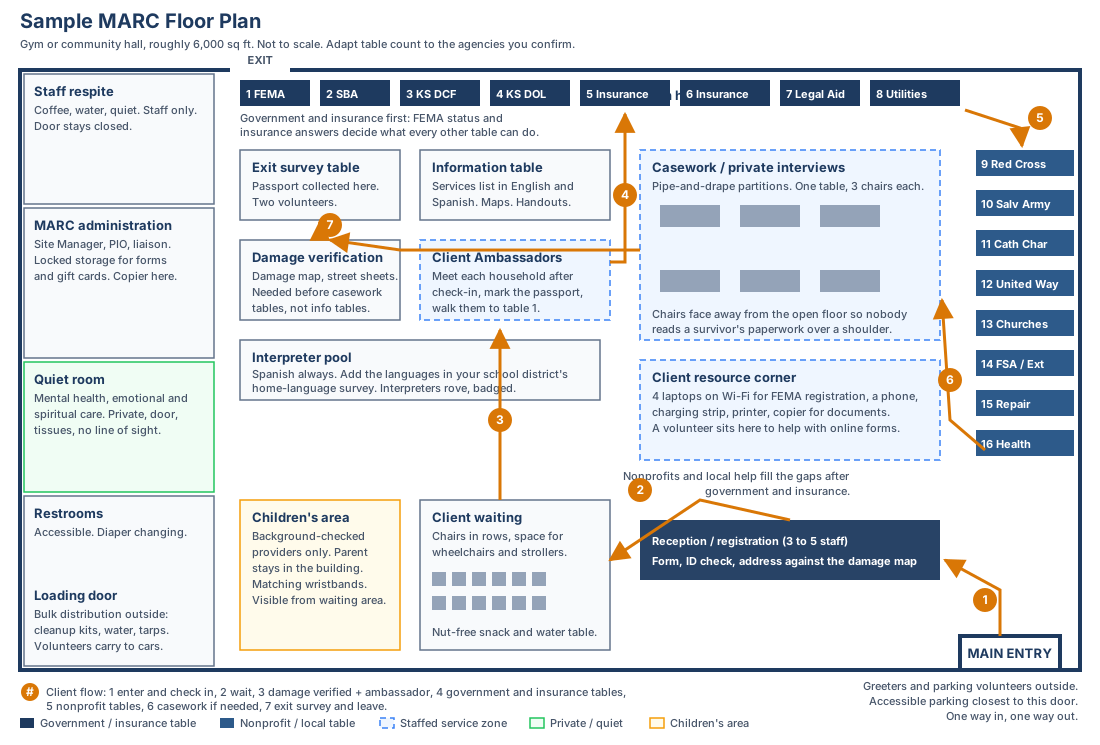
A sample layout from the toolkit, adapted from the national planning resource. The numbered circles are the client flow. Renumber the tables for the agencies you confirm, and keep the order.
Rural counties: take the MARC to the people
When a tornado track leaves damaged homes thirty miles apart, one big MARC at the county seat will miss the far end of the county. Run half-day MARCs in each affected town instead, with three or four agencies in a community center.
What a survivor experiences
They park where a volunteer points them and walk in. A greeter hands them a clipboard with a one-page registration form, points them to the chairs, and quietly notices whether this family needs a wheelchair, an interpreter or the quiet room.
The form asks what every table will need and nothing more: name, phone, the damaged address, where they are staying now, how many people and their ages, whether they own or rent, whether they have insurance, whether they have registered with FEMA, and a checklist of needs. It does not ask about immigration status. At the registration table, someone finds their address on the damage map and marks them verified, and a family that cannot prove anything is not turned away. The forms live in a locked box, and only the lead agency and case management see them.
An ambassador in an orange vest sits down with them, reads the checklist, and circles the tables on the passport: FEMA, their insurance company, the social services agency for the freezer full of food they lost, the chainsaw crew. At each table, the representative reads the registration form instead of starting from zero and initials the passport. At the exit, a volunteer collects the passport, hands them a cleanup kit, and makes sure they have one phone number to call next week.
The people who run it
A MARC serving a hundred or so families a day needs roughly twenty-five to thirty-five people beyond the agency representatives. Most are volunteers, and they should be affiliated, trained volunteers for anything that touches families.
The site manager runs the building: one person, named by the lead agency, who approves spending and press releases, chairs the morning huddle, and settles disputes between agencies. A partner agency liaison keeps the roster of agencies present, collects their forms and code of conduct, and assigns tables. The public information officer owns every public message and every reporter at the door, and a safety and security lead handles parking, crowd flow, exits and the evacuation plan. Reception takes three to five people who are calm with paperwork and calm with upset people. Ambassadors are the heart of the operation; four to six of them, in vests, who know what every table does. Greeters, runners and two or three parking volunteers round out the floor.
Three specialist roles are easy to under-staff and expensive to skip. Interpreters, roving and badged, for every language in the damage area, which the school district's home-language survey will tell you. Childcare by a licensed provider or a credentialed disaster childcare team. And emotional and spiritual care in the quiet room for every open hour: a counselor from the community mental health center and a chaplain. Every person who sits at a table also signs the MARC code of conduct: serve everyone with dignity, keep client information confidential, do not solicit, do not photograph survivors, refer media to the PIO.
What goes wrong, and what to do about it
The FEMA or insurance line gets long. Pull a volunteer with a laptop into the line to start registrations while people wait, and offer callback appointments.
An agency does not show up. Never leave the table empty: put their handouts and phone number there with a volunteer, collect the names of everyone who needed them, and hand that list to the agency the same afternoon.
A family arrives with nothing. Serve them anyway; most agencies can start a file and follow up on documents. Point the family to legal aid and vital statistics.
Someone breaks down. The ambassador walks them to the quiet room without an audience, and the counselor or chaplain takes it from there. Train every volunteer in the basics of psychological first aid before the doors open.
Reporters come inside. Media coverage is how survivors find out about the next MARC, so welcome it, through the PIO only. No photographs of faces or paperwork.
A truck of donated clothes pulls up. Thank the driver and send the truck to the donations site.
The sky turns green. If you are opening in severe weather season, the safety lead has already identified the shelter area during the walk-through.
After the doors close
The MARC is a starting point, and whether it actually helped anyone is decided in the two weeks after it closes. That part is the lead agency's responsibility.
Within 48 hours, compile the numbers: households and people served, the needs people checked, how many visits each table got. Thank every agency publicly by name; that is how you get them back next time. Return the building cleaner than you found it.
Within two weeks, work the follow-up list. Every family that checked "yes, call me" gets a call, and every agency that promised a follow-up gets asked whether it happened. Then hand the registration data, with its consents, to disaster case management or the long-term recovery group. Then write a short after-action report and send it to the state VOAD.
Free MARC Toolkit
Everything above, packaged for the week you decide to hold one: a planning guide, a floor plan, a forms pack and a state agency contact list. Free, no sign-up.
| Download | What's inside | Pages |
|---|---|---|
| MARC Planning Guide | The countdown from decision to doors open, site selection, client flow, roles with headcounts and who usually fills them, which agency to invite for which need, a day-of run sheet, supplies, and the after-action checklist | 12 |
| Sample Floor Plan | The gym layout shown above, letter landscape, with the numbered client flow | 1 |
| Forms Pack | Client registration, client passport, partner agency form and code of conduct, daily agency log, exit survey in English and Spanish, agency invitation letter, press release and social post, half-page flyer in English and Spanish, opening and closing checklists, partner debrief | 11 |
| State Agency Contact List | Federal, state and VOAD agencies for one state, with what each brings to a table and how to reach them. Kansas edition available now; other states on request. | 5 |
State editions of the planning guide add a state agency table and a page of local considerations. The Kansas edition is available now; we build others on request.
The forms and checklists are modeled on the appendices of the Multi-Agency Resource Center Planning Resource (American Red Cross, Catholic Charities USA and The Salvation Army, 2015, reviewed by FEMA). The hub page at responseteam.org/tools/marc-toolkit/ has browser versions of each document and the sources.
Another state?
Email team@serve.love with your state and county and we will build that sheet from your state's FEMA referral list and VOAD roster.
Frequently Asked Questions
How soon after a disaster should we hold a MARC?
Five to fourteen days. Earlier, families are still sheltering and not ready to fill out forms. Later, they have scattered or given up. Do not wait for a federal declaration.
What if there is no federal declaration and FEMA is not coming?
Hold it anyway. The state social services and labor agencies, legal aid, the insurance companies, the Red Cross, the Salvation Army, Catholic Charities, the food bank and the local churches are most of what a family needs. Put a few laptops in the resource corner so people can register with FEMA online.
How many people should we expect?
Plan for half to three quarters of affected households over a two-day event, and for the high end if promotion is strong.
Who pays for it?
Usually nobody, in cash. Schools and churches donate the building, the county prints the forms, the Red Cross or Salvation Army feeds the room, and partner agencies bring their own people and materials. If there are real costs, a community foundation or the local disaster relief fund generally covers them.
Should we hold more than one?
Often. A second MARC two or three weeks later catches families who missed the first and everyone with new questions after FEMA and insurance letters arrive.
Do we really need interpreters?
Yes. Spanish at minimum almost everywhere, and more in many communities; the school district's home-language survey tells you which. Many agencies bring their own interpreters, so coordinate ahead and keep a phone interpretation service as backup.
Can the MARC also be our volunteer sign-up and donations drop-off?
No. Each of those is its own operation with its own site, and mixing them in overwhelms the room and the survivors. Put a sign at the door with the address of the volunteer reception center and the donations site.
Ready to Organize Your MARC?
Download the free toolkit: planning guide, floor plan, forms pack and state agency contact lists. Other states on request.
Planning Guide (PDF) Floor Plan (PDF) Forms Pack (PDF) Kansas Edition (PDF)
See the full toolkit page or email team@serve.love for another state.
Related Guides
- Standing Up an LTR Where the MARC's registration data goes next
- Who Does What: Partner Roles Understand the agencies before you invite them
- Working with Your State VOAD One call that reaches every nonprofit at once
- Claremore Case Study How a MARC fit into a real response